


Coinbase's Trustpilot Rating Is Total Bull💩: How Fake Reviews Inflate a Shady Score

You know that feeling when you see a restaurant with a 4.5-star rating on Google, but when you actually eat there, the food tastes like it was prepared by someone who learned to cook from a cereal box? Yeah, well, welcome to the wonderful world of manipulated online reviews, where companies like Coinbase have turned Trustpilot into their personal PR playground.
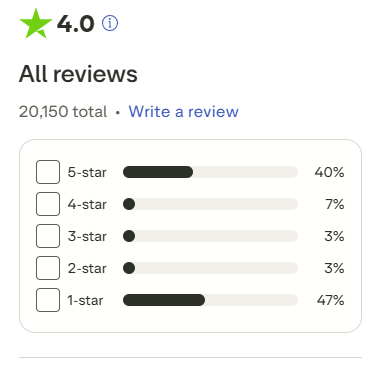
Here's a fun fact that'll make your blood boil: Coinbase sits pretty with a shiny 4.0 rating on Trustpilot despite, and I cannot stress this enough, nearly half of their 20,000+ reviews being 1-star disasters. That's not just bad math; that's straight-up corporate sorcery that would make Enron's accounting team jealous.
The Numbers Don't Add Up (And That's the Point)
Let's break this down like we're explaining it to a five-year-old who just discovered that Santa isn't real. When 50% of people reviewing your service had the worst possible experience, basic arithmetic says your average rating should be somewhere around "dumpster fire" territory, not "pretty good, would recommend."
But somehow, Coinbase has cracked the code. And by "cracked the code," I mean they've figured out how to game Trustpilot's system harder than a casino regular with a card-counting habit.
The secret sauce? Strategic review bombing with fake positivity. Here's how it works:
Step 1: Customer has a positive interaction (maybe their deposit actually went through without vanishing into the crypto void)
Step 2: Immediately blast them with review invitations while they're still in that brief moment of not wanting to burn down the internet
Step 3: Collect vague, context-free "great service!" reviews from people who haven't yet discovered their funds are locked in digital purgatory
Step 4: Watch your average climb while real customers are still waiting three months for someone to respond to their support tickets
It's brilliant in the most evil, manipulative way possible.
What Fake Reviews Actually Look Like
Want to spot a fake Coinbase review? It's easier than finding Waldo in a crowd of brunettes. Here's your field guide to manufactured positivity:
The Fake Review Starter Pack:
Ultra-short and sweet: "Great app!" or "Easy to use, recommended!"
Zero context: No mention of what they actually did, how long they used it, or any specific features
Suspiciously international: Lots of reviews from countries where English clearly isn't the first language, but somehow they all use identical phrasing
Copy-paste energy: Title and body text often eerily similar, like they were written by the same AI bot having a really boring day
These aren't reviews, they're digital participation trophies.

Meanwhile, in Reality Land...
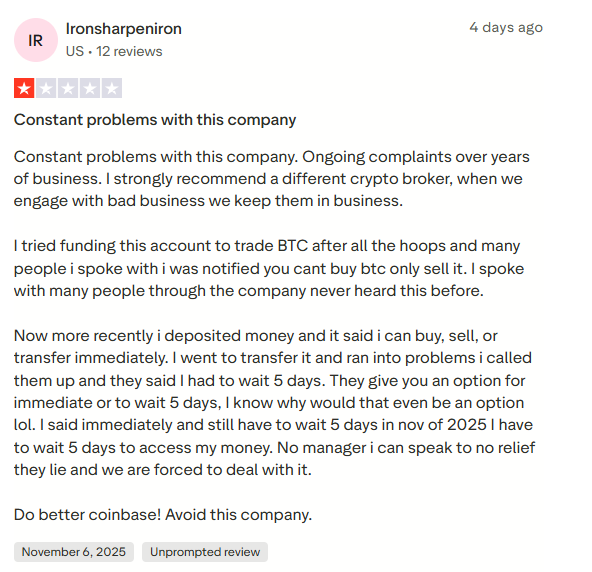
Now let's talk about the real reviews, the 1-star novels that read like Stephen King wrote them during a particularly dark period of his life. These aren't angry rants from entitled customers; they're desperate pleas from people who've been financially kneecapped by a company that treats customer service like an optional subscription feature.
What actual Coinbase horror stories look like:
Account lockouts: "I've been locked out of my account for 73 days with $15,000 trapped inside"
Vanishing funds: "My Bitcoin disappeared after a transfer, support says they're 'investigating' since March"
Support black holes: "Ticket #47829 has been 'escalated to specialists' for 4 months with zero updates"
Social media begging: "Please help, I've posted on every Coinbase social media account for weeks"
These people aren't just mad, they've moved past the five stages of grief and landed somewhere between "acceptance" and "planning their own cryptocurrency exchange out of spite."
Trustpilot: The Enabler in Chief
Here's where things get really spicy. Trustpilot isn't just passively allowing this manipulation, their algorithm is practically designed to reward it. Companies can flood their profiles with invited reviews right after positive interactions, and Trustpilot's system weights these "recent" reviews more heavily than older ones.
It's like having a grading system where your teacher only counts the homework you turned in on days when you felt confident, and ignores all the tests where you drew pictures of cats instead of answering questions.
Trustpilot's role in this corporate theater:
Allows companies to aggressively invite reviews after cherry-picked interactions
Weights recent reviews more heavily, letting companies bury bad periods under fresh fake positivity
Enables profile merging that can combine different rating periods and confuse the data
Provides AI-assisted response tools that let companies reply to 97% of negative reviews with generic corporate-speak
Oh, and here's my favorite part: Coinbase responds to almost every negative review with some variation of "We're sorry to hear about your experience! Please DM us your details so we can help!" Then...crickets. It's like corporate thoughts and prayers: looks good for PR, accomplishes absolutely nothing.
The Geographic Tell
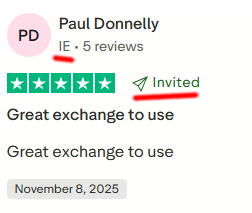
Want to know a dirty little secret? Look at where these glowing reviews are coming from versus where the horror stories originate. Spoiler alert: American customers: you know, the ones actually dealing with U.S. banking regulations and Coinbase's full "service" experience: are writing reviews that make "The Shining" look like a cheerful bedtime story.
Meanwhile, those suspiciously positive reviews often come from international users who might have had completely different experiences, or worse, might not even be real users at all. For example, the user below is from Ireland:
How to Read Review Sites Like a Detective
Look folks, I'm not saying you should never trust any online reviews ever again (though honestly, that's not terrible advice). But when you're dealing with companies that handle your actual money, you need to read between the lines like your financial future depends on it. Because it does.
Your BS Detection Toolkit:
Ignore the overall rating completely: it's about as meaningful as a participation trophy
Sort by most recent and read the 1-star reviews first: these people have nothing to gain by lying
Look for detailed, specific complaints rather than vague praise
Check review dates: are there suspicious clusters of positive reviews right after bad publicity?
Pay attention to reviewer locations: are the good reviews coming from places that seem random?
Read what the company says in response: are they actually helping or just performing customer service theater?
The Bigger Picture: When Reviews Become Weapons
Here's the thing that really gets me fired up: Coinbase isn't unique in this. They're just really, really good at it. Companies across every industry have figured out that online reviews are no longer about customer feedback: they're about reputation warfare.
And platforms like Trustpilot are either too naive to see the manipulation or too profitable to care about stopping it. Either way, consumers are the ones getting screwed while corporate America plays rating system hopscotch with our trust.
What You Can Actually Do About It
I know, I know: this whole situation feels like trying to fight the ocean with a spoon. But here's the deal: knowledge is power, and now you know how to see through the BS.
Your action plan:
Never rely solely on aggregated ratings for important financial decisions
Read the detailed negative reviews to understand what can actually go wrong
Look up complaints on Reddit, Twitter, and consumer forums where companies have less control
Check multiple review platforms to see if ratings are consistent across sites
Research the company's actual customer service record through consumer protection agencies
The Bottom Line
That 4.0 rating on Coinbase's Trustpilot page? It's not a grade: it's a magic trick. And like most magic tricks, once you know how it's done, it stops being impressive and starts being insulting.
Companies like Coinbase love gaming review platforms because it works. What they don't love? Being called out for it. And that's exactly what we do here at Customer Service Hell.
So the next time you see a suspiciously high rating for a company with a reputation for nightmare customer service, remember this: take that score with a grain of salt, read the 1-star reviews like your money depends on it, and trust your gut over some manipulated algorithm.
Because in the world of fake reviews and corporate reputation management, your skepticism might be the only honest thing left.
Comments